
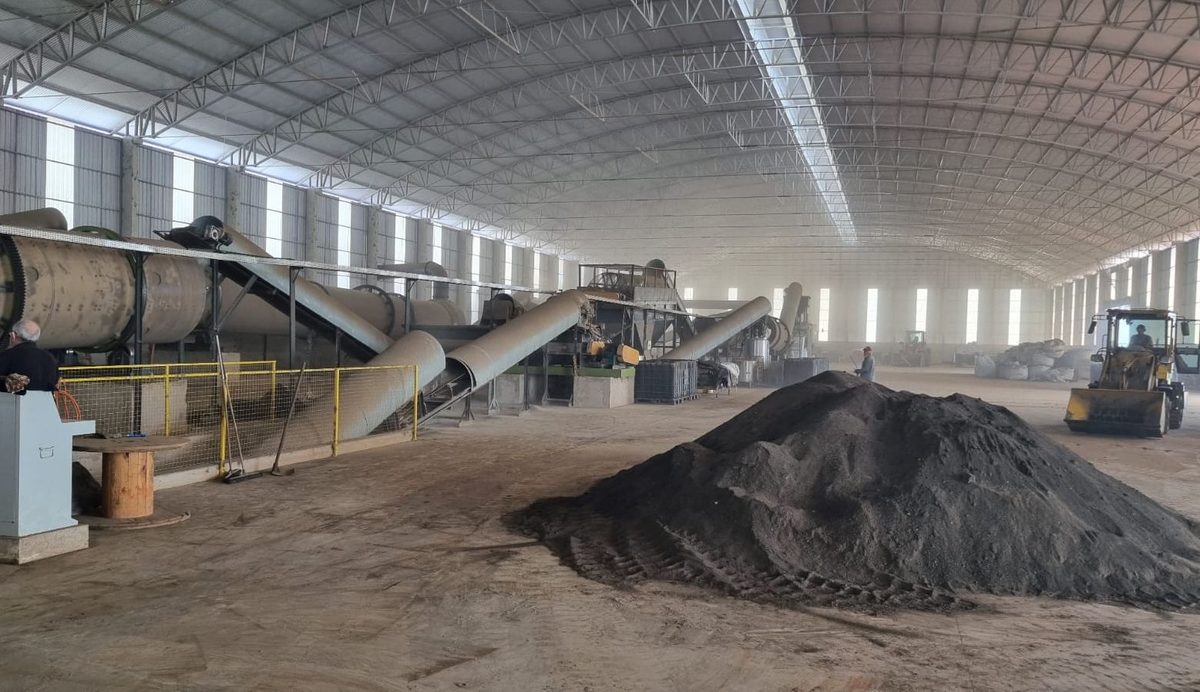
At a glance
Customer: Regional fertigation fertilizer brand
Problem: Manual batching could not hold the micro-nutrient accuracy their label promised
Solution: We started from the recipe, not from the machines. Micro-dosing scales were placed before the mixer so trace elements were metered at the accuracy the formula required; the QL urea crusher was moved upstream to protect m...
Result: Consistent batch-to-batch uniformity with recipe traceability
| Customer type | Regional fertigation fertilizer brand |
| Industry / project type | Линия порошковых водорастворимых удобрений |
| Capacity | 5 t/h · 5–25 kg bags |
| Country / region | Middle East |
Start a similar project
Tell us your raw materials, capacity and target market. We will compare your conditions with this project and recommend the right configuration.
Product Inquiry
Tell us about your project — we reply within 24 hours (24/7).
Why the project happened
The customer is a fertilizer brand serving drip and greenhouse farmers, expanding from imported finished product into in-house powder WSF production. They needed consistent batch quality, traceability for their COA, and export-grade packing - not just a set of machines.
What the customer faced
These are the specific issues the project was built to solve.
- Manual batching could not hold the micro-nutrient accuracy their label promised
- Caked urea and brittle salts created lumps that failed solubility checks
- Dust at mixing and packing made the plant unpleasant and wasted product
- They had no batch record, so every shipment needed extra lab re-testing
- Packing was manual, limiting output and weight compliance
Limits we designed around
Real projects are never ideal. These constraints shaped the configuration and delivery plan.
- Frequent formula changes across 10+ WSF SKUs
- Corrosive salts required stainless contact parts
- 5-25 kg bag flexibility plus ton-bag export runs
- Site space was limited, so the line had to be compact and dust-tight
Why we configured it this way
We started from the recipe, not from the machines. Micro-dosing scales were placed before the mixer so trace elements were metered at the accuracy the formula required; the QL urea crusher was moved upstream to protect mixing; a ribbon mixer with fast cleanout handled formula changeover; and a dust-controlled buffer plus automatic bagging and robotic palletizing closed the train. Every batch weighing is logged in the PLC, which gives the customer the data for a COA.
How it was delivered
From requirements confirmation to commissioning - the key nodes of this project.
Requirements & design
Collected formula, bulk density, bag sizes and automation target; produced process flow and layout in 2 weeks.
Fabrication
Stainless contact parts, micro-scales and PLC built and no-load tested in our plant.
Quality control
Pre-shipment test run, weighing calibration and packing documentation confirmed.
Delivery & installation
Export-packed and shipped; installation supervised on site with operator training.
Commissioning & acceptance
Run at target capacity with 20-bag weight audit and batch traceability report.
Difficult points and how we solved them
Micro-ingredient accuracy at 0.01-0.1% of batch
Independent micro-scales with loss-in-weight dosing and recipe lock-in, verified with trial batches.
Caked urea in hot climate
QL stainless crusher upstream with 20-30 mesh target before metering.
Dust control in a compact plant
Negative-pressure de-dusting at every transfer point and a low-drop buffer.
What changed after delivery
Verifiable changes from this project. Where specific figures are confidential, we state the direction and the evidence.
- Consistent batch-to-batch uniformity with recipe traceability
- 3-person packing operation replacing a larger manual crew
- COA-ready batch reports from the PLC for every production run
- Customer expanded the SKU range without reconfiguring the line
Project outcome
Стабильная однородность партий с прослеживаемостью рецептур и операцией фасовки в 3 человека.
What similar customers can learn
For other WSF brands, this project shows that accuracy and traceability are line-design decisions, not add-on options. If you export or sell to regulated buyers, put micro-dosing, stainless contact parts and batch logging into the base configuration - retrofitting them later costs more than designing them in.
Questions from similar projects
How do you guarantee micro-ingredient accuracy?
What bag sizes can this line handle?
Can the line produce a COA automatically?
Your conditions, our configuration
The fastest way to a useful answer is to compare your project against this one: raw materials, capacity, bag size, site and destination.
Product Inquiry
Tell us about your project — we reply within 24 hours (24/7).