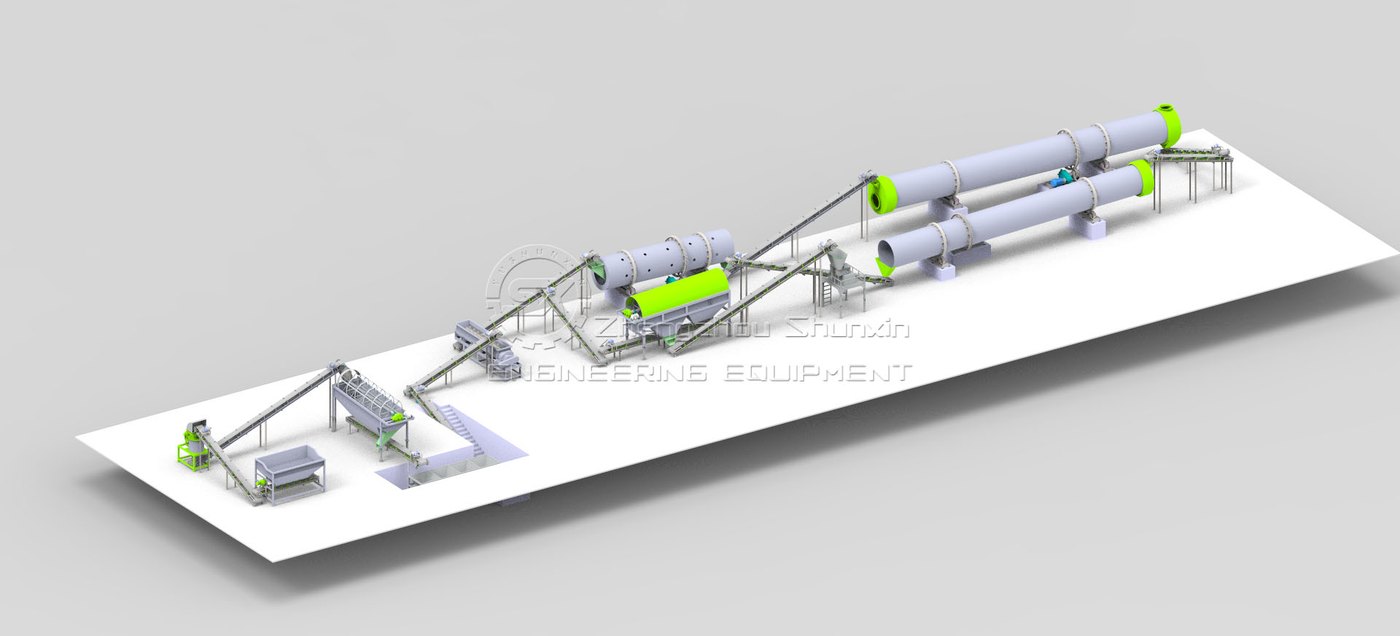
Home/Solutions/Controlled-Release Urea Coating Production Line
Controlled-Release Urea Coating Production Line
Sulfur-coated and resin-coated controlled-release urea for large urea granules — engineered melting, spraying, curing, cooling and packing, with a 10 t/h sulfur-coating reference line.
North AmericaEuropeJapan / KoreaChinaSoutheast AsiaMiddle East
Solution at a glance
Controlled-Release Urea Coating Production Line
YUSHUNXIN builds controlled-release urea coating lines around two proven chemistries: sulfur-coated urea (SCU) and resin-coated urea (RCU/PCU). The line starts from large granular urea, preheats and screens it, then applies either a molten sulfur shell with a wax, bitumen or vegetable-oil seal, or a multi-layer polymer film with controlled curing. Coating mass, layer count and curing are engineered to design release windows from about 30 to 180 days. A 10 t/h sulfur-coating line is the reference configuration; resin lines are sized per project.
Two routes: sulfur-coated urea (SCU) or resin-coated urea (RCU/PCU)
Designable release windows from 30 to 180 days
10 t/h sulfur-coating reference line
Melting, spraying, curing, cooling and packing in one train
Controlled-release urea is a premium upgrade to large granular urea: it reduces nitrogen loss, smooths supply across the crop cycle and supports one-pass basal application. The engineering choice between sulfur and resin is a cost-versus-stability trade, and we keep both on one platform so the line is matched to the market segment rather than forced into a single coating chemistry.
Read this first: the solution fits specific customers, scenarios and project stages. If you are not the target, the configuration and quote will not be right.
Suitable for
Large granular urea producers and exporters
Controlled-release fertilizer brands
BB blend and basal-application compound producers
Agricultural input groups entering slow-release products
Not suitable / confirm first
Standard anti-caking coating only (choose the fertilizer coating machine)
Projects without a target release window or granule-size specification
Small-volume research without production-scale throughput
The problems
What customers face before this solution
These are the real operating problems this line is designed to solve - and why they happen.
Typical problems
Bare large granular urea releases too fast and risks nitrogen loss
Sulfur shells crack under rough blending, transfer or spreading
Resin films release unevenly when curing is not controlled
Coated granules arrive warm, sticky or out of size without post-coating cooling and screening
Why they happen
Coating mass and layer count not matched to the release window
Sulfur shell treated as a single thick layer instead of layered spraying with a seal
Resin curing temperature and residence time not controlled
No screening loop after coating, so agglomerates and undersize reach the bag
Why a complete line, not single machines
Controlled-release performance is the product, not the coating machine alone. Melting or resin preparation, metering, spraying, curing, cooling and screening must be one balanced line; a machine bought in isolation cannot hold the release window.
Process
How the line works
1
Granule Receiving, Screening & Preheating
Large granular urea is screened for size uniformity and preheated so coating materials bond evenly.
2
Sulfur Route: Molten Sulfur Spraying
Melted sulfur is metered and sprayed in thin layers onto the moving granule surface to build a rigid sulfur shell.
3
Sulfur Sealing Layer
Wax, bitumen or vegetable-oil wax is applied over the sulfur shell to seal micro-pores and micro-cracks and tune initial release.
4
Resin Route: Multi-Layer Polymer Spraying
A resin solution (polyurethane, polyolefin or degradable resin) is sprayed in successive thin films to form a continuous, flexible membrane.
5
Curing & Film Formation
Temperature and residence time are controlled so each film cures evenly and the designed release profile is repeatable.
6
Cooling & Screening
Coated granules are cooled to handling temperature and screened to remove oversize, agglomerates and undersize.
7
Weighing & Packing
Finished controlled-release urea is bagged at 25–50 kg or packed into FIBC ton bags for storage and blending.
Solution structure
What is inside the line
Each module solves one part of the chain. Open any module to see its parameters and options.
Equipment is not a list - it is a response to your conditions. This is how your conditions change the configuration:
When your project is...
We configure...
Sulfur route, cost-sensitive market
Layered molten-sulfur spraying plus wax or oil sealing, sized at 10 t/h reference
Resin route, premium precision release
Multi-layer resin spraying with controlled curing and solvent recovery where required
Both products on one line
Separate sulfur and resin preparation, metering and spraying systems with changeover plan
Long-season crops or one-pass basal use
Longer release window through higher coating mass or more resin layers
Scenario differences
Different projects get different configurations
We do not apply one template to every customer. Here are three common scenarios and how the configuration changes.
BB blend producer
Focus: Cost-stable controlled-release base granules
Sulfur route with sealing, cooling and screening feeding the blender
Premium resin brand
Focus: Smooth 30-180 day release curves
Multi-layer resin route with tight curing and film-control instrumentation
Urea exporter adding value
Focus: Premium product from standard large granular urea
Coating, cooling and packing module added after existing urea handling
Implementation
From inquiry to commissioning
This is the delivery path we follow for every complete line project.
1
Confirm requirements
Raw materials, formula, capacity, bag size, utilities and site conditions are confirmed in a technical questionnaire.
2
Process design & layout
We produce a process flow, line layout and foundation drawings sized to your material data.
3
Quotation with scope
You receive a quotation with an itemized delivery scope - what is included and what is excluded.
4
Order & fabrication
Fabrication starts with progress updates; long-lead items are ordered first.
5
Factory testing
Machines are assembled and no-load tested; weighing and control systems are calibrated.
6
Export packing
Equipment is export-packed with anti-rust treatment and a packing list for customs.
7
Delivery & installation
Machines ship FOB/CIF/door-to-door; installation is supervised on site or via video guidance.
8
Commissioning & training
We commission the line, train your operators and stabilize process parameters.
9
Acceptance & after-sales
Acceptance is based on agreed metrics; spares and remote support continue after handover.
Pre-purchase checklist
What to prepare before requesting a quote
The better your information, the closer the first quote is to the final one. Prepare these items:
Urea granule size, hardness and temperature
Coating chemistry: sulfur, resin, or both
Target release window (30, 60, 90, 120 or 180 days)
Capacity t/h and operating hours
Resin type, degradability and solvent recovery
Packing size and destination market
Request a controlled-release urea coating assessment
Send granule size, coating chemistry, target release window, capacity and packaging; our engineers will return a line configuration and reference parameters.
Product Inquiry
Tell us about your project — we reply within 24 hours (24/7).
Risk boundaries
When this solution does not apply
Honest boundaries make a proposal credible. These conditions must be confirmed before the configuration is valid:
Sulfur shells are brittle - gentle conveying and handling are part of the scope
Release performance must be confirmed by product trials and the customer's acceptance method
Resin type and degradability are customer-selected; microplastic claims require third-party evidence
Coating mass changes capacity and raw-material cost - confirm the release window before sizing
Effect verification
How we verify the solution works
Performance is checked with measurable indicators, not adjectives. These are the acceptance checks for this type of line:
Indicator
How it is verified
Release window
Water or soil incubation trial per the agreed method
Coating mass and uniformity
Weighing and visual/instrument inspection per batch
Granule size after coating
Sieve analysis after cooling and screening
Throughput
Record t/h at design conditions
Delivery scope
What is included - and what is not
Compare quotes on the same scope. This is exactly what the project price covers.
Included
Urea coating, curing, cooling, screening and packing modules
Metered sulfur melting or resin solution system
PLC recipe management for coating layers
Layout, installation supervision, commissioning and training
Not included (separate scope)
Urea feedstock supply
Resin and solvent supply
Civil works and utilities
Third-party environmental or agronomic certification
Scenario FAQ
Questions buyers ask about this solution
What is the difference between sulfur-coated and resin-coated urea?
Sulfur-coated urea uses a molten sulfur shell plus a wax, bitumen or vegetable-oil seal; the shell is brittle but low-cost and adds sulfate. Resin-coated urea uses a continuous, flexible polymer film in multiple layers; it is more expensive but gives smoother, temperature-driven release and does not add sulfur.
What release periods can you design?
By adjusting coating mass, layer count and resin formulation we can design common 30, 60, 90, 120 and 180 day windows. The target release is confirmed by product trials, not by a single machine setting.
What coating mass is typical?
Sulfur shells usually make up 15–30% of granule mass because thickness controls release duration. Resin films are typically 3–8% of granule mass.
Can one line coat with both sulfur and resin?
Yes. We can configure a line for both routes with separate preparation, metering and spraying systems, or optimize for one chemistry. The choice depends on your product mix and changeover needs.
Is sulfur-coated urea fragile?
The sulfur shell is a rigid inorganic layer and can crack under rough blending, transfer or mechanical spreading. We size gentle conveying and handling, and the sealing layer reduces micro-cracks, but the limitation is real and is part of the engineering discussion.
Does the coating add nutrients?
The sulfur route supplies crop-available sulfate as the shell oxidizes in soil. The resin film itself supplies no nutrient.
What do you need for a quotation?
Urea granule size and hardness, coating chemistry, target release window, capacity and packaging. We also confirm resin type and any solvent-recovery or degradable-resin requirements.
Which route should I choose, sulfur or resin?
Sulfur is the lower-cost route and adds sulfate but is more brittle; resin gives smoother, temperature-driven release and better mechanical durability at a higher cost. We recommend after confirming your market position and release target.
Can I start at 10 t/h for sulfur coating?
The sulfur route is referenced at 10 t/h for large granular urea. Resin lines and other capacities are sized per project from the same module set.
Deep-dive guide
Ten angles buyers must understand before investing
Each angle is a self-contained chapter with a line illustration. Read the ones that match your project stage, then send us the data each angle asks for.
1. Two coating routes, one decision: sulfur versus resin
Sulfur-coated urea is a cost-driven route: a rigid sulfur shell plus a wax or oil seal slows nitrogen release and adds sulfate, but the shell can crack under rough handling. Resin-coated urea uses a continuous, flexible polymer film in several layers, giving smoother temperature-driven release and better mechanical durability at a higher cost. Keeping both routes on one platform lets the line follow the market segment instead of forcing every customer into one chemistry.
2. Why sulfur-coated urea is the low-cost controlled-release route
Molten sulfur is sprayed onto large granular urea in thin layers until the shell reaches the thickness the release window needs. The shell is rigid, so the process and the handling equipment must protect it. The sulfur route is the entry point for controlled-release products where cost per tonne matters more than a perfectly smooth release curve.
3. How the wax or oil seal changes release
The sulfur shell contains micro-pores and micro-cracks. A sealing layer of wax, bitumen or vegetable-oil wax closes part of those pores, repairs cracks and slows the initial burst of nitrogen. Because the seal is part of the release design, the sealing material and dosage are specified with the sulfur thickness rather than added as an afterthought.
Resin films are continuous, dense and flexible, with no rigid cracks. Water vapor passes through the membrane, dissolves urea inside, and osmotic pressure drives nutrient release. Temperature is the main control variable, which matches crop demand through the growing season better than a brittle shell. Resin mass is only 3–8% of granule mass, but the resin and application cost more.
5. Coating mass and release windows: 15–30% versus 3–8%
Sulfur shells are thick because thickness controls release duration, so the coating typically represents 15–30% of granule mass. Resin membranes achieve the same design range with 3–8% coating mass because the film itself is a dense barrier. This difference changes raw-material cost, capacity sizing and the energy balance of the line.
6. The 10 t/h urea sulfur coating reference line
The reference line is sized at 10 t/h for large granular urea: preheating, metered molten-sulfur spraying, sealing, cooling, screening and packing. Resin lines and other capacities are engineered from the same module set, with the preparation and dosing systems matched to the selected chemistry and the target release window.
7. Curing, cooling and screening: protecting the membrane
After coating, the granules need controlled residence time for the seal or film to cure, followed by cooling to a handling-safe temperature. Screening removes agglomerates and undersize before packing. These post-coating stages are as important as the spray itself; skipping them leaves a membrane that is still soft or sticky.
8. From coated granules to BB blends and one-pass basal application
Coated urea granules are commonly blended into BB fertilizer or applied as a one-pass basal dose for long-season crops, reducing or eliminating top-dressing labor. The release window is selected for the crop and climate, and the coated granules must survive blending and spreading without cracking — which is why the sulfur and resin routes are matched to the use case.