
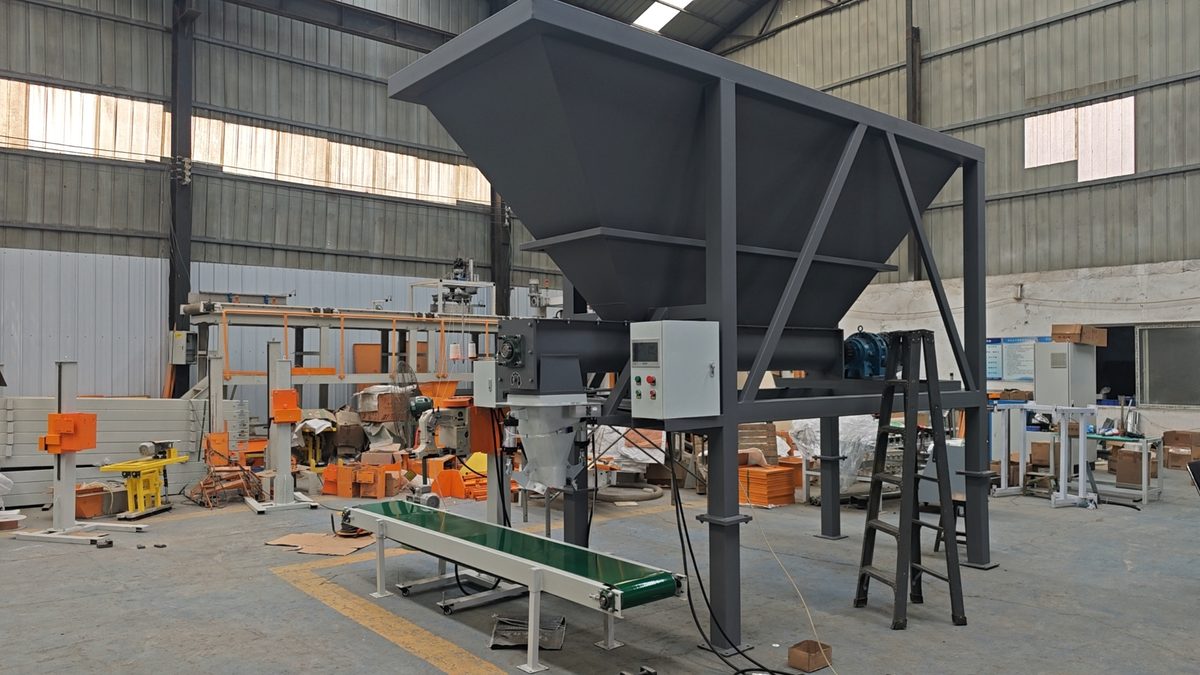
El material de parche frío asfáltico es pegajoso, sensible a la temperatura y más difícil de limpiar de las superficies de contacto que el fertilizante seco. Envasarlo requiere una ruta de llenado y sellado dedicada, mientras que el empaque automático en sacas necesita un peso de llenado estable y un traspaso limpio al paletizado.
Hay máquinas de ensacado de cabezal simple y doble disponibles para el material de parche frío, y el empaque automático en sacas usa alimentación de bolsa enrollada o bolsa preformada con llenado estable y verificación de peso. La secuencia de envasado sigue dosificación, llenado, sellado, verificación de peso y paletizado, y el manejo de material especial incluye consideraciones de superficie de contacto y limpieza para un producto pegajoso o sensible a la temperatura.
El equipo admite formatos de bolsa y saca, con el número de cabezales ajustado a la producción objetivo, y las propuestas técnicas documentan el trazado de la línea y la integración con la alimentación de material aguas arriba. El comprador puede especificar una línea de envasado para materiales pegajosos o especiales sin forzar una empacadora estándar de fertilizante, y puede elegir salida de cabezal simple, doble o en saca según el caudal.
La forma práctica de usar este artículo es llevar sus tres ángulos a la discusión de especificación: fijar primero la materia prima y el objetivo del producto, pedir el alcance de entrega ítem por ítem y acordar los puntos de aceptación antes de la orden. Cuando envase un material especial, la película de la bolsa y el método de sellado son la primera decisión, no la velocidad del llenador. Envíe el material, el peso de bolsa y el requisito de sellado, y devolveremos la configuración de llenado y de saca que mantiene el producto sellado y la nave limpia.
The packaging update adds single-head and double-head bagging machines for asphalt cold-patch material and an automatic FIBC ton-bag packing line. This article explains the process sequence and where special-material handling differs from standard fertilizer packing.
Event background
Asphalt cold-patch material is sticky, temperature-sensitive and harder to clean from contact surfaces than dry fertilizer. Packing it requires a dedicated filling and sealing path, while automatic ton-bag packing needs stable fill weight and clean handoff to palletizing.
Key facts
- Single-head and double-head bagging machines are available for asphalt cold-patch material.
- Automatic ton-bag (FIBC) packing uses a roll-bag or pre-made bag feed with stable fill and checkweighing.
- The packing sequence follows metering, filling, sealing, checkweighing and palletizing.
- Special-material handling includes contact-surface and cleaning considerations for sticky or temperature-sensitive product.
- The equipment supports bag and FIBC formats, with head count matched to target throughput.
- Technical proposals document the line layout and integration with upstream material supply.
What this means for customers
The buyer can specify a packaging line for sticky or special materials without forcing a standard fertilizer packer, and can choose single-head, double-head or FIBC output by throughput. Special-material bagging such as asphalt cold-patch shows why the bag and the sealing method are fixed from the material, not from a standard filler. The practical way to use this article is to carry its three angles into your specification discussion. First, fix the feedstock and the product target before the machine, because the line is sized from the material, not from a catalogue number. Second, ask the supplier to state the delivery scope item by item, including the conveying, the dust system, the installation and the training, so competing offers are compared on the same basis. Third, agree the acceptance points before the order, so the capacity, the accuracy and the product quality are measured rather than assumed. When all three are written down, the quotation becomes a project plan, and the supplier who can answer them clearly is usually the one who can also deliver the plant on time and keep it running afterwards.
How we support this
YUSHUNXIN supplies special-material bagging and automatic FIBC packing lines, with technical proposals prepared for layout, filling accuracy and cleaning.
Next steps
Provide material type, target bag size, throughput and whether FIBC or small bags are required; we will return a packaging configuration. When you pack a special material, the bag film and the sealing method are the first decision, not the filler speed. Send the material, the bag weight and the sealing requirement, and we will return the filling and ton-bag configuration that keeps the product sealed and the hall clean.
Related pages
Explore complete production lines
Línea de Producción de Fertilizante Soluble en Agua (Polvo)Línea de Producción de Fertilizante OrgánicoLínea de Producción de Fertilizante Compuesto NPKAutomatización de Envasado y Paletizado de FertilizantesSistemas de Separación Física de Aguas Residuales GanaderasLínea de Granulación de Negro de CarbónAll production lines