
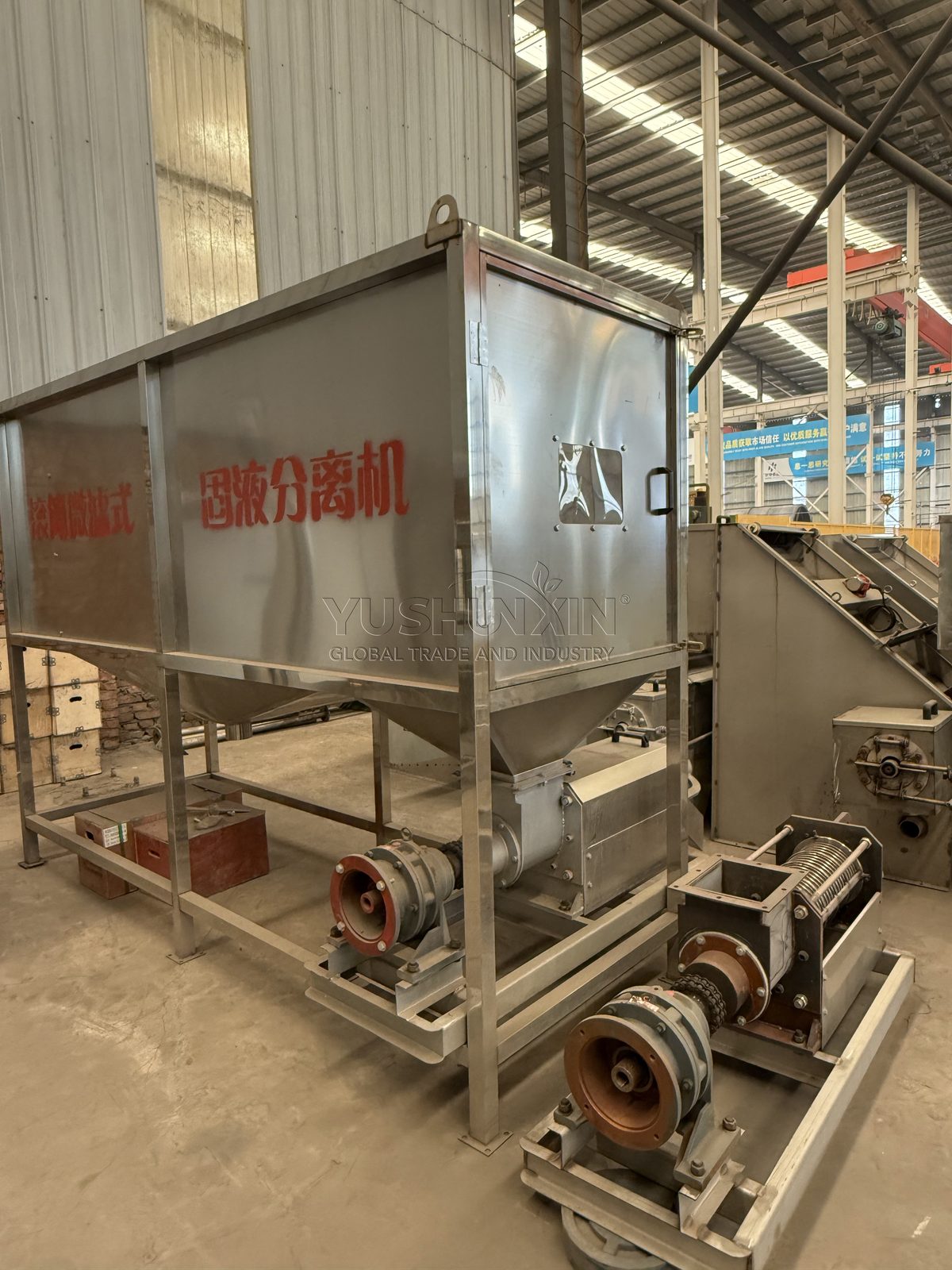
Livestock Wastewater Physical Separation Systems
YUSHUNXIN's livestock wastewater range reduces suspended-solids load at the front of your treatment line: an inclined screen removes coarse fiber and large particles, a high-frequency fine screening separator (reference 0.3 mm / 150 mesh) captures fine solids at 30–50 m³/h, and a volute screw press dewaters concentrated solids. This is physical solid-liquid separation and suspended-solids reduction — it is not a substitute for full biological or chemical treatment to discharge standards.
Reference 30–50 m³/h fine separation unit
0.3 mm / 150-mesh 304 stainless screen
~95% solids interception at reference conditions
Clear boundary: physical separation, not discharge treatment
Why choose this line
Livestock wastewater separation is one of the company's fastest-growing new lines and the honest front-end of manure management: reduce suspended-solids load, recover solids for composting, and shrink the biological or chemical treatment you still need. The engineering boundary is explicit — physical separation, not discharge treatment.
Is this solution for you?
Read this first: the solution fits specific customers, scenarios and project stages. If you are not the target, the configuration and quote will not be right.
Suitable for
- Pig, cattle and poultry farms facing high solids load in wastewater
- Farms connecting manure solids to composting or organic fertilizer lines
- Environmental projects that need a reliable front-end load reduction before biological treatment
- Contractors integrating separation into existing treatment trains
Not suitable / confirm first
- Customers expecting discharge-compliant water from separation alone (that is biological/chemical treatment scope)
- Projects without flow, TS/SS data or a defined solids destination
- Sites with no access for solids removal and dewatering disposal
What customers face before this solution
These are the real operating problems this line is designed to solve - and why they happen.
Typical problems
- Raw wastewater carries high suspended solids that clog pumps, pipes and downstream treatment
- Solids are not recovered, so nutrients and fiber that could feed composting are lost
- Manual screening is labor-intensive and inconsistent
- Fine particles pass coarse screens, overloading downstream biological treatment
- Separated solids are too wet to compost or transport economically
- Equipment corrodes and clogs because the system was not designed for manure characteristics
Why they happen
- Only a coarse screen is installed, so fines pass through
- No primary settling or fine separation stage matched to flow peaks
- Solids are removed manually with no dewatering, so they are heavy and messy
- Flow and TS content were never measured, so the system is sized on guesses
- Dewatering and composting interfaces are not planned, so separated solids have no route
- Carbon steel contact parts corrode in the aggressive liquid environment
Why a complete line, not single machines
Separation is a chain of particle-size reduction: coarse solids, fine suspended solids and bound water each need a different stage. A single screen or press cannot do all three. A two-stage physical system with dewatering is designed around your flow, TS and fiber profile, and it turns a wastewater problem into a recoverable solids stream.
How the line works
Collection & Homogenization
Manure pump and control package delivers consistent flow from collection pits.
Coarse Separation
Inclined screen removes fiber and large particles to protect downstream units.
Fine Separation
High-frequency vibrating fine separator captures fine solids (reference 0.3 mm / 150 mesh).
Dewatering
Volute screw press concentrates fine solids and sludge with reduced moisture.
Output
Separated solids can be further composted; liquid continues to your existing treatment or storage.
What is inside the line
Each module solves one part of the chain. Open any module to see its parameters and options.
Why we configure it this way
Equipment is not a list - it is a response to your conditions. This is how your conditions change the configuration:
| When your project is... | We configure... |
|---|---|
| High coarse solids | Inclined coarse screen or drum screen as first stage |
| Fine suspended solids | High-frequency fine separator (0.3-0.5 mm) as second stage |
| Wet solids for composting | Volute screw press or screw dewaterer to reduce moisture |
| High flow variability | Equalization tank + variable-speed pumps with flow control |
| Corrosive environment | Stainless or coated contact parts and sealed bearings |
Different projects get different configurations
We do not apply one template to every customer. Here are three common scenarios and how the configuration changes.
Large pig farm
Focus: Reliable load reduction and solids recovery
Coarse screen + fine separator + screw press, solids to composting
Cattle farm with bedding
Focus: Fiber and grit handling
Heavy-duty screen + settling + dewatering with fiber-tolerant design
Integrated treatment project
Focus: Downstream protection
Two-stage separation sized to protect the biological plant
From inquiry to commissioning
This is the delivery path we follow for every complete line project.
Confirm requirements
Raw materials, formula, capacity, bag size, utilities and site conditions are confirmed in a technical questionnaire.
Process design & layout
We produce a process flow, line layout and foundation drawings sized to your material data.
Quotation with scope
You receive a quotation with an itemized delivery scope - what is included and what is excluded.
Order & fabrication
Fabrication starts with progress updates; long-lead items are ordered first.
Factory testing
Machines are assembled and no-load tested; weighing and control systems are calibrated.
Export packing
Equipment is export-packed with anti-rust treatment and a packing list for customs.
Delivery & installation
Machines ship FOB/CIF/door-to-door; installation is supervised on site or via video guidance.
Commissioning & training
We commission the line, train your operators and stabilize process parameters.
Acceptance & after-sales
Acceptance is based on agreed metrics; spares and remote support continue after handover.
What to prepare before requesting a quote
The better your information, the closer the first quote is to the final one. Prepare these items:
- Animal type and housing/collection method
- Wastewater flow in m3/h or m3/day and peak factor
- TS/SS content and fiber/grit characteristics (or samples)
- Target solids removal and downstream liquid destination
- Solids destination (composting, transport, disposal) and moisture target
- Site power, space and access
- Environmental or discharge requirements for context
Request a separation system scoping
To scope your separation system, send: animal type and collection method, flow (m3/h) and peaks, TS/SS data or samples, target solids removal, solids destination and site conditions.
Product Inquiry
Tell us about your project — we reply within 24 hours (24/7).
When this solution does not apply
Honest boundaries make a proposal credible. These conditions must be confirmed before the configuration is valid:
- This is a physical separation system: it reduces solids load, it does not achieve discharge compliance by itself
- Performance depends on real flow and TS data; without samples, quotes are preliminary only
- High-fiber or high-grit streams may need heavier-duty internals
- Solids disposal and composting are customer scope, but we design the interface
How we verify the solution works
Performance is checked with measurable indicators, not adjectives. These are the acceptance checks for this type of line:
| Indicator | How it is verified |
|---|---|
| SS removal | Measure TS/SS before and after each stage over a full day |
| Dewatered solids moisture | Check solids moisture at the press outlet |
| Hydraulic capacity | Record m3/h at design and peak flow |
| Uptime | Track clogging events and cleaning time over the first month |
What is included - and what is not
Compare quotes on the same scope. This is exactly what the project price covers.
Included
- Screens, separators, dewatering press, pumps and control as one system
- Flow and solids design basis
- Layout, installation guidance, commissioning and training
- Spare parts and after-sales support
Not included (separate scope)
- Biological or chemical treatment stages (we size the interface for them)
- Civil works, lagoons and disposal logistics
- Composting equipment (separate scope; we coordinate)
- Environmental permits