
Línea de Producción de Fertilizante Soluble en Agua (Polvo)
Producción de WSF en polvo con fórmula precisa, control de polvo y total automatización — desde la recepción de materias primas hasta el producto envasado y paletizado.
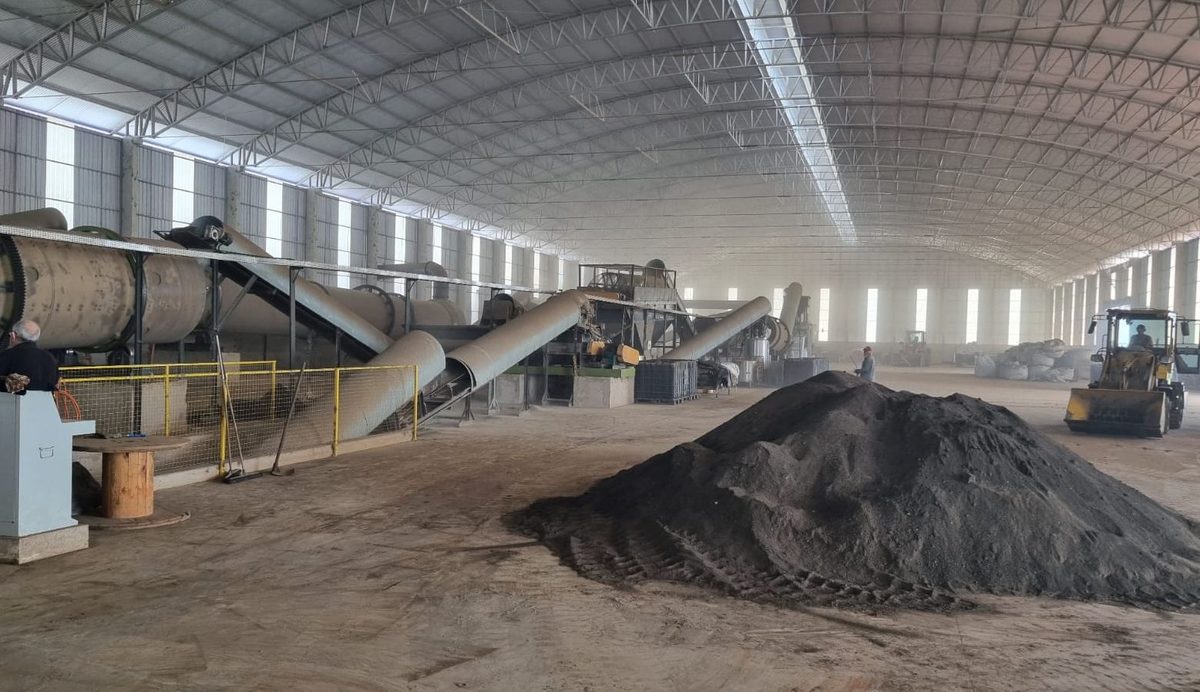
Línea de Producción de Fertilizante Soluble en Agua (Polvo)
YUSHUNXIN diseña plantas de fertilizante soluble en polvo alrededor de cinco objetivos de ingeniería innegociables: precisión de fórmula, uniformidad de mezcla, control de polvo, cambio rápido de receta y automatización de envasado. El proceso se organiza como un tren de polvo continuo: recepción y volcado de sacos → trituración de materiales apelmazados (trituradora de urea QL) → dosificación multicomponente → mezcla de alta uniformidad → cribado y deducción de polvo → buffer antisedimentación → envasado de 5–50 kg o sacos FIBC → paletizado. La capacidad se configura según los objetivos del proyecto y la densidad aparente — nunca fijamos una sola cifra.
Gestión de recetas por PLC con trazabilidad de lotes
Partes en contacto de acero inoxidable para sales corrosivas
Control de polvo en recepción, trituración, mezcla y envasado
Cambio rápido de receta con limpieza de bajo residuo
Why choose this line
Powder WSF is the fastest-growing precision-fertilizer route for foliar and fertigation brands. Instead of manual blending, a YUSHUNXIN line locks five control points — formulation accuracy, mixing uniformity, dust control, fast recipe changeover and packaging automation — so every batch is repeatable and export-documentable.
Is this solution for you?
Read this first: the solution fits specific customers, scenarios and project stages. If you are not the target, the configuration and quote will not be right.
Suitable for
- Fertigation and water-soluble fertilizer brands that need repeatable, documented batch quality
- Greenhouse input distributors and agronomy companies adding private-label WSF production
- Existing fertilizer plants upgrading from manual batching to automated, dust-controlled lines
- Producers exporting 5-25 kg, 25-50 kg or FIBC ton-bag WSF to regulated markets
Not suitable / confirm first
- Customers who expect the supplier to own the chemical formulation (formulation stays with the customer or a joint process-validation project)
- Projects without confirmed raw materials, bulk density or target bag size - these must be fixed before line design
- Very small pilot plants below roughly 0.5 t/h that may be better served by a single mixer and bagger
What customers face before this solution
These are the real operating problems this line is designed to solve - and why they happen.
Typical problems
- Batch-to-batch nutrient content varies because metering is manual and trace elements are skipped or guessed
- Caked urea and brittle salts enter the mixer uncrushed, leaving lumps that fail solubility tests
- Dust escapes at dumping, crushing, mixing and packing, increasing operator exposure and product loss
- Mixed powder segregates in long conveyors and high-drop chutes before packing, undoing mixer uniformity
- Recipe changeover is slow and residues contaminate the next batch
- Packing weight compliance is poor for export markets and bag changeovers are labor-intensive
- No batch record exists, so customers cannot issue a credible Certificate of Analysis (COA)
Why they happen
- Weighing is manual or single-scale, so micro ingredients are never dosed at the accuracy the formula needs
- Crushing is placed downstream of batching or omitted, so lumps are metered and mixed instead of being reduced first
- Dust collection is added only at one point, while every transfer and open discharge generates dust
- Conveying and buffering are designed for granules, not powders, so free-flowing powder segregates by particle size
- Mixer internals and ducts are hard to clean, so residuals from the previous formula contaminate the next
- Bagging is manual or the bagger is not integrated with a checkweigher, so weight drift is discovered late
- There is no recipe database or batch log, so quality cannot be traced to a production run
Why a complete line, not single machines
A single high-uniformity mixer cannot fix upstream metering errors or downstream segregation, and a single bagger cannot fix weight drift if the product arriving at the hopper is non-uniform. A WSF line is a chain: crushing, metering, mixing, de-dusting, buffering and packing must be engineered to the same recipe and the same bulk density. When one link is undersized, the whole line underperforms - which is why we scope the complete train rather than selling machines in isolation.
How the line works
Recepción y volcado de sacos
Estaciones de volcado de sacos/FIBC, deducción de polvo, separación magnética y transporte por tornillo o vacío.
Trituración de apelmazados
La trituradora QL de acero inoxidable reduce urea apelmazada y sales frágiles a 20–30 mallas antes de dosificar.
Dosificación multicomponente
Básculas por pérdida/ganancia de peso para macronutrientes más micro-básculas independientes para oligoelementos.
Mezcla de alta uniformidad
Mezcladoras horizontales, de doble eje o de cinta dimensionadas por lote, uniformidad y frecuencia de limpieza.
Cribado y deducción
El cribado vibratorio elimina sobretamaños y cuerpos extraños; aspiración en todos los puntos con polvo.
Buffer antisedimentación
Silo de producto terminado de corta retención con transporte de baja caída.
Envasado y paletizado
Envasadoras automáticas de 5–25 kg o 25–50 kg, sacos FIBC, control de peso, paletizado robótico o de alto nivel y enfardado.
What is inside the line
Each module solves one part of the chain. Open any module to see its parameters and options.
Why we configure it this way
Equipment is not a list - it is a response to your conditions. This is how your conditions change the configuration:
| When your project is... | We configure... |
|---|---|
| High traceability / COA requirement | PLC recipe management with per-batch weighing logs, micro-scales for trace elements, and optional label/COA printing |
| Corrosive salts (NPK water-soluble, magnesium sulfate, potassium nitrate) | 304/316 stainless steel contact parts and sealed bearing housings |
| Fine, dusty or hygroscopic material | Negative-pressure de-dusting at every transfer point, low-drop anti-segregation buffer, and dust-tight packing |
| Frequent formula changeover | Ribbon or twin-shaft mixer with fast cleanout, quick-release ducts, and vacuum or short screw conveying |
| Export weight compliance | Net-weight bagger with checkweigher, reject gate, robotic or high-level palletizer and stretch wrapping |
| Small batch / many SKUs | Gain-in-weight or loss-in-weight micro-dosing with recipe storage for fast switchover |
Different projects get different configurations
We do not apply one template to every customer. Here are three common scenarios and how the configuration changes.
Fertigation brand (many SKUs)
Focus: Recipe traceability, micro-dosing accuracy, 5-25 kg bag flexibility
PLC recipes + micro-scales + ribbon mixer + robotic palletizing with pattern change
Contract toll blender
Focus: Fast changeover and low residue
Quick-clean mixer + short conveying + dedicated dust collection + washable contact surfaces
Export producer (ton-bags)
Focus: High throughput and weight compliance
High-capacity metering + FIBC packer + checkweigher + high-level palletizing
From inquiry to commissioning
This is the delivery path we follow for every complete line project.
Confirm requirements
Raw materials, formula, capacity, bag size, utilities and site conditions are confirmed in a technical questionnaire.
Process design & layout
We produce a process flow, line layout and foundation drawings sized to your material data.
Quotation with scope
You receive a quotation with an itemized delivery scope - what is included and what is excluded.
Order & fabrication
Fabrication starts with progress updates; long-lead items are ordered first.
Factory testing
Machines are assembled and no-load tested; weighing and control systems are calibrated.
Export packing
Equipment is export-packed with anti-rust treatment and a packing list for customs.
Delivery & installation
Machines ship FOB/CIF/door-to-door; installation is supervised on site or via video guidance.
Commissioning & training
We commission the line, train your operators and stabilize process parameters.
Acceptance & after-sales
Acceptance is based on agreed metrics; spares and remote support continue after handover.
What to prepare before requesting a quote
The better your information, the closer the first quote is to the final one. Prepare these items:
- Formula and raw material list (including trace elements and additives)
- Raw material bulk density and moisture (or we help you measure them)
- Target capacity in t/h or bags per hour
- Bag type and weight (5-25 kg / 25-50 kg / FIBC ton-bag)
- Required automation level (manual / semi-auto / full PLC with traceability)
- Site voltage and frequency (e.g. 380V/50Hz, 415V/50Hz, 440V/60Hz)
- Available plant footprint and floor layout
- Dust-control or food-safety requirements for your market
- Export packaging and destination port
Request a WSF line configuration
To configure your powder WSF line, send: formula and raw materials, bulk density (if known), target t/h, bag sizes, automation level, site voltage and destination port.
Product Inquiry
Tell us about your project — we reply within 24 hours (24/7).
When this solution does not apply
Honest boundaries make a proposal credible. These conditions must be confirmed before the configuration is valid:
- Capacity claims depend on bulk density and flowability; we confirm after material data, never with an untested fixed number
- Chemical formulation is not included in equipment scope unless agreed as a joint process-validation project
- Hygroscopic raw materials may require dry storage and climate control outside our equipment scope
- Extremely sticky or non-free-flowing powders may need pre-tests before the line is finalized
- Civil works, site wiring, compressed air and building services are customer scope unless separately quoted
How we verify the solution works
Performance is checked with measurable indicators, not adjectives. These are the acceptance checks for this type of line:
| Indicator | How it is verified |
|---|---|
| Mixing uniformity | Sample 5-10 points per batch, test N-P-K / trace element content, and compare coefficient of variation before acceptance |
| Line capacity | Run 3 consecutive hours at target recipe and record t/h and bags/h |
| Weight compliance | Check 20 consecutive bags on the checkweigher against your legal tolerance |
| Changeover time | Time one recipe switch including cleaning and first conforming bag |
| Dust control | Measure visible dust at operator positions or compare dust-collector pressure drop against design |
| Traceability | Generate a batch report with raw material lots, weighings and timestamp for one production run |
What is included - and what is not
Compare quotes on the same scope. This is exactly what the project price covers.
Included
- Process design and line layout for your capacity
- All equipment from bag dumping to palletizing, engineered as one train
- PLC recipe management with batch logging (optional level)
- Dust collection and de-dusting at process transfer points
- Installation drawings, supervision or on-site commissioning
- Operator training and operating documentation
- Spare-parts list and long-term wear-part supply
Not included (separate scope)
- Chemical formulation and raw material supply
- Civil works, foundations, building and site wiring
- Compressed air generation beyond the machine package
- Local permits, certifications and third-party testing
- Raw material storage silos outside the process train (quoted separately)