
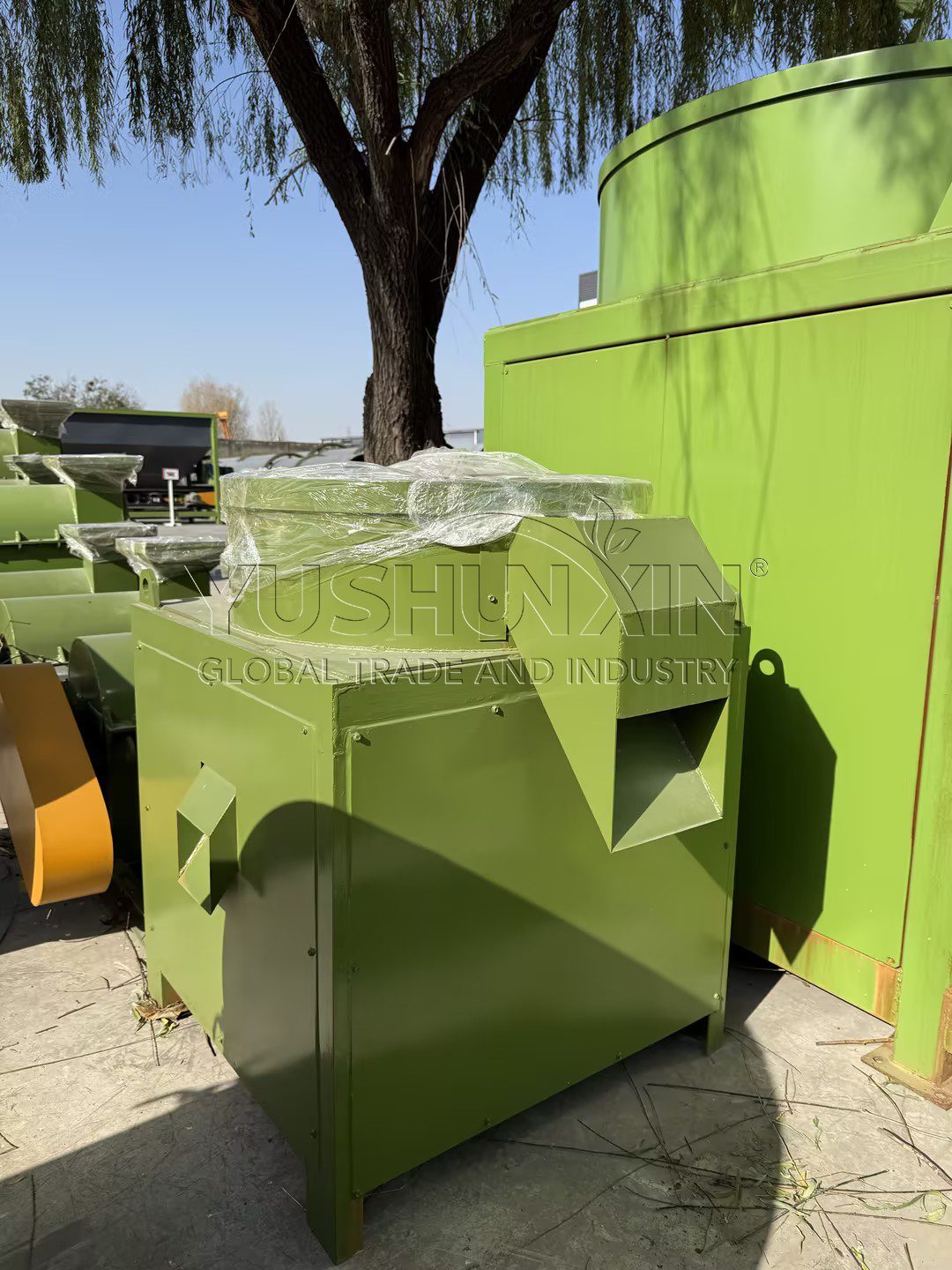
خط تحبيب الأسمدة المعدنية
للأسمدة المعدنية ومحسّنات التربة، تقدم YUSHUNXIN مسارات ضغط جاف بالبكرتين وتحبيباً قرصياً يتجنبان طاقة التجفيف العالية ويناسبان المواد الخام المعدنية المسحوقة.
تحبيب جاف منخفض الطاقة
معالجة الزيوليت والمساحيق المعدنية
غربلة وتكامل إعادة التدوير
تعبئة حسب المواصفات
Why choose this line
Mineral fertilizer and soil-amendment granulation is a company growth track that turns mineral powders, zeolite and ore-based materials into handleable granules without high drying energy — opening low-cost production for regional mineral fertilizer brands.
Related solutions
Is this solution for you?
Read this first: the solution fits specific customers, scenarios and project stages. If you are not the target, the configuration and quote will not be right.
Suitable for
- Producers granulating zeolite, bentonite, dolomite, limestone and other mineral powders
- Slow-release and soil-conditioner brands needing consistent granules
- Mining and mineral processors adding value to fine powder by-products
- Organic-mineral fertilizer producers blending mineral powders with organic inputs
Not suitable / confirm first
- Projects needing chemical granulation with high moisture and drying (use NPK wet route)
- Customers without a defined target particle size and strength
- Single-machine needs (a disc granulator alone) - see product pages
What customers face before this solution
These are the real operating problems this line is designed to solve - and why they happen.
Typical problems
- Mineral powders are fine and abrasive, wearing out standard fertilizer equipment quickly
- Granules are weak or dusty without the right binder and moisture control
- Drying high-moisture mineral granules is energy-intensive and slow
- Granule size distribution is inconsistent, causing customer complaints
- Abrasive dust damages bearings, screws and seals
- Standard fertilizer lines are over-engineered for simple dry minerals, raising cost
Why they happen
- Equipment is selected from a general fertilizer catalog without wear review
- Binder and moisture are not tuned to the mineral's particle surface
- A wet granulation route is chosen where dry compaction would be cheaper
- No screening loop, so fines and oversize are not returned
- Wear parts are not hardened or easily replaceable
- Line design does not match the mineral's specific density and flow behavior
Why a complete line, not single machines
Mineral granulation is a wear- and binder-engineering problem. The right route (disc, roller compaction or extrusion) depends on the mineral's plasticity, moisture and target granule. A complete line matches conditioning, granulation, screening and handling to the mineral, so granules are consistent and the equipment survives abrasive dust.
How the line works
Feeding & Metering
Mineral powder is metered from silos or bag-dumping stations.
Crushing / Grinding (Optional)
Lumps and coarse fractions are reduced before mixing.
Mixing with Binder
Binder and additives are homogenized for consistent granulation.
Dry Granulation
Double-roller compaction or disc granulation forms granules with minimal drying.
Screening & Packing
Classification, recycle of fines and automatic packing.
What is inside the line
Each module solves one part of the chain. Open any module to see its parameters and options.
Why we configure it this way
Equipment is not a list - it is a response to your conditions. This is how your conditions change the configuration:
| When your project is... | We configure... |
|---|---|
| Dry, non-plastic minerals | Double-roller compaction with dynamic batching - no drying required |
| Moisture-tolerant minerals | Disc or drum granulation with matched binder and low-temperature drying |
| High abrasion | Hardened wear plates, sealed bearings and easily replaceable liners |
| Tight size range | Screening loop with fines and oversize return |
| Low energy requirement | Dry route prioritized; drying only when granule strength requires it |
Different projects get different configurations
We do not apply one template to every customer. Here are three common scenarios and how the configuration changes.
Zeolite producer
Focus: Consistent granules, low dust
Roller compaction + screening loop + bagging
Soil conditioner brand
Focus: Organic-mineral blends
Batching + gentle granulation + drying/cooling as required
Mining by-product valorization
Focus: Turn fine powder into saleable granules
Validation-first design with hardened equipment
From inquiry to commissioning
This is the delivery path we follow for every complete line project.
Confirm requirements
Raw materials, formula, capacity, bag size, utilities and site conditions are confirmed in a technical questionnaire.
Process design & layout
We produce a process flow, line layout and foundation drawings sized to your material data.
Quotation with scope
You receive a quotation with an itemized delivery scope - what is included and what is excluded.
Order & fabrication
Fabrication starts with progress updates; long-lead items are ordered first.
Factory testing
Machines are assembled and no-load tested; weighing and control systems are calibrated.
Export packing
Equipment is export-packed with anti-rust treatment and a packing list for customs.
Delivery & installation
Machines ship FOB/CIF/door-to-door; installation is supervised on site or via video guidance.
Commissioning & training
We commission the line, train your operators and stabilize process parameters.
Acceptance & after-sales
Acceptance is based on agreed metrics; spares and remote support continue after handover.
What to prepare before requesting a quote
The better your information, the closer the first quote is to the final one. Prepare these items:
- Mineral type, particle size, hardness and moisture
- Target granule size, strength and dust tolerance
- Capacity in t/h and operating hours
- Binder availability and cost
- Energy availability (drying route) and site utilities
- Destination market and packing requirements
Request a mineral granulation assessment
To assess your mineral granulation project, send: mineral type, particle size, hardness, moisture, target granule specs, capacity, binder options and site utilities.
Product Inquiry
Tell us about your project — we reply within 24 hours (24/7).
When this solution does not apply
Honest boundaries make a proposal credible. These conditions must be confirmed before the configuration is valid:
- Granule strength depends on the mineral-binder combination; validation with samples is required before guarantees
- Abrasive minerals increase wear-part consumption - we specify hardened parts and realistic maintenance intervals
- Some minerals are hygroscopic and require dry storage outside equipment scope
- Drying energy can dominate cost for wet routes; we present the dry alternative first
How we verify the solution works
Performance is checked with measurable indicators, not adjectives. These are the acceptance checks for this type of line:
| Indicator | How it is verified |
|---|---|
| Granule strength and size | Drop/compression test and sieve analysis per shift |
| Fines content | Measure after screening and at the bagger |
| Wear-part life | Track liner and roller wear over the first 500 operating hours |
| Throughput | Record t/h at design conditions |
| Energy per ton | Compare kWh/t for wet vs dry route options |
What is included - and what is not
Compare quotes on the same scope. This is exactly what the project price covers.
Included
- Batching, conditioning, granulation, screening, conveying and bagging
- Wear-engineered contact parts
- Layout, installation, commissioning and training
- Spare parts and after-sales support
Not included (separate scope)
- Binder supply
- Mining, milling and upstream powder processing
- Civil works and utilities
- Third-party product certification